PlacePrep AI
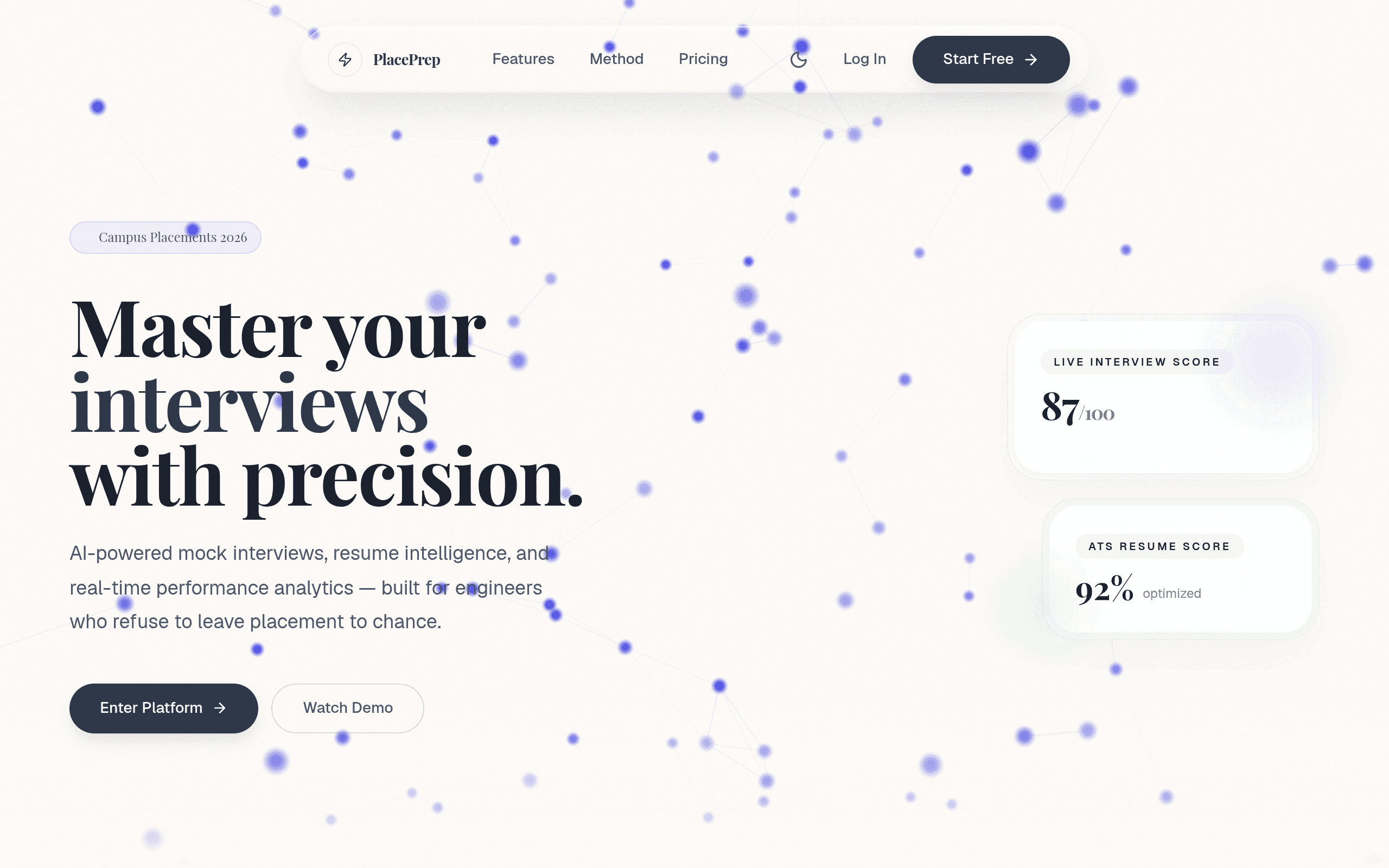
The Concept
An intelligent institutional placement preparation gateway elevating the placement journey from an opaque process to a precise, data-driven science.
Purpose
To act as a personal mentor, a rigorous interviewer, and an ATS-savvy resume critic—all wrapped in a responsive glassmorphism interface.
The Call
Students face opaque hiring criteria and lack immediate feedback; PlacePrep AI strips away the noise and provides structured institutional analytics.
The Forge: Neural Semantic Vector Matching & Dual-Stream ATS Engine
What it does
An advanced NLP document analysis engine utilizing sentence-transformer embeddings and dual-stream PDF decoders to calculate cosine similarity against target Job Descriptions.
Why it exists
Standard ATS tools rely on naive keyword counts which fail on synonyms. The Forge projects candidate experience into high-dimensional semantic vector space for true contextual alignment.
How it works
Combines SentenceTransformer (all-MiniLM-L6-v2) cosine similarity tensors with PyMuPDF/pdfplumber fallback streams and weighted keyword-gap heuristics in asynchronous Python workers.
# ── NEURAL SEMANTIC EMBEDDING & DUAL-STREAM ATS ENGINE ──
from sentence_transformers import SentenceTransformer, util as st_util
import fitz        # PyMuPDF low-level stream decoder
import pdfplumber

_st_model = SentenceTransformer("all-MiniLM-L6-v2")

async def match_jd_semantic_stream(resume_path: str, jd_text: str) -> Dict[str, Any]:
    # Phase 1: Dual-Engine PyMuPDF / pdfplumber fallback text stream
    text = ""
    try:
        with pdfplumber.open(resume_path) as pdf:
            text = "\n".join(page.extract_text() or "" for page in pdf.pages)
    except Exception:
        doc = fitz.open(resume_path)
        text = "\n".join(page.get_text() for page in doc)

    # Phase 2: Vector embedding & Cosine Similarity tensor projection
    resume_emb = _st_model.encode(text, convert_to_tensor=True, show_progress_bar=False)
    jd_emb = _st_model.encode(jd_text, convert_to_tensor=True, show_progress_bar=False)

    # High-dimensional semantic distance calculation (0.00 - 1.00)
    semantic_score = float(st_util.cos_sim(resume_emb, jd_emb)[0][0])

    # Phase 3: Sectional weighted heuristic & keyword gap matrix
    return {
        "semantic_match": round(semantic_score * 100, 2),
        "skills_coverage": calculate_skill_overlap(text, jd_text),
        "readiness_index": compute_weighted_ats(semantic_score, text)
}The Crucible: Real-Time Audio Cadence, Sentiment & Telemetry Stream
What it does
A real-time evaluation pipeline analyzing speech delivery cadence (WPM), hesitation token frequency, and vocal pitch confidence overlaid with Three.js 3D meshes and Recharts telemetry.
Why it exists
Gives candidates instant diagnostic feedback on vocal delivery and confidence before they sit in real institutional hiring rounds.
How it works
WebAudio API analyser nodes stream real-time decibel energy and frequency bands synced with Whisper transcription streams to evaluate confidence, pacing, and response logic.
// ── REAL-TIME VOCAL CADENCE & CONFIDENCE EVALUATION ──
export function evaluateCrucibleCadence(transcriptStream: string[], audioFrequencies: Uint8Array, durationSec: number) {
  // 1. Words-Per-Minute & Hesitation Token Analysis
  const totalWords = transcriptStream.join(" ").split(/\s+/).filter(Boolean).length;
  const wpm = Math.round((totalWords / durationSec) * 60);
  const hesitationMatches = transcriptStream.join(" ").match(/\b(um|uh|like|you know|basically)\b/gi) || [];

  // 2. Frequency Band Variance (Vocal Pitch & Steady Energy)
  const rmsEnergy = Math.sqrt(audioFrequencies.reduce((sum, v) => sum + v * v, 0) / audioFrequencies.length);
  const cadenceScore = wpm >= 120 && wpm <= 160 ? 95 : Math.max(50, 95 - Math.abs(140 - wpm) * 0.8);

  // 3. Composite Confidence Coefficient
  const confidenceIndex = Math.max(10, Math.min(99, Math.round(
    cadenceScore * 0.6 + (rmsEnergy * 0.25) - (hesitationMatches.length * 4)
  )));

  return { wpm, confidenceIndex, clarity: hesitationMatches.length === 0 ? 98 : 82 };
}